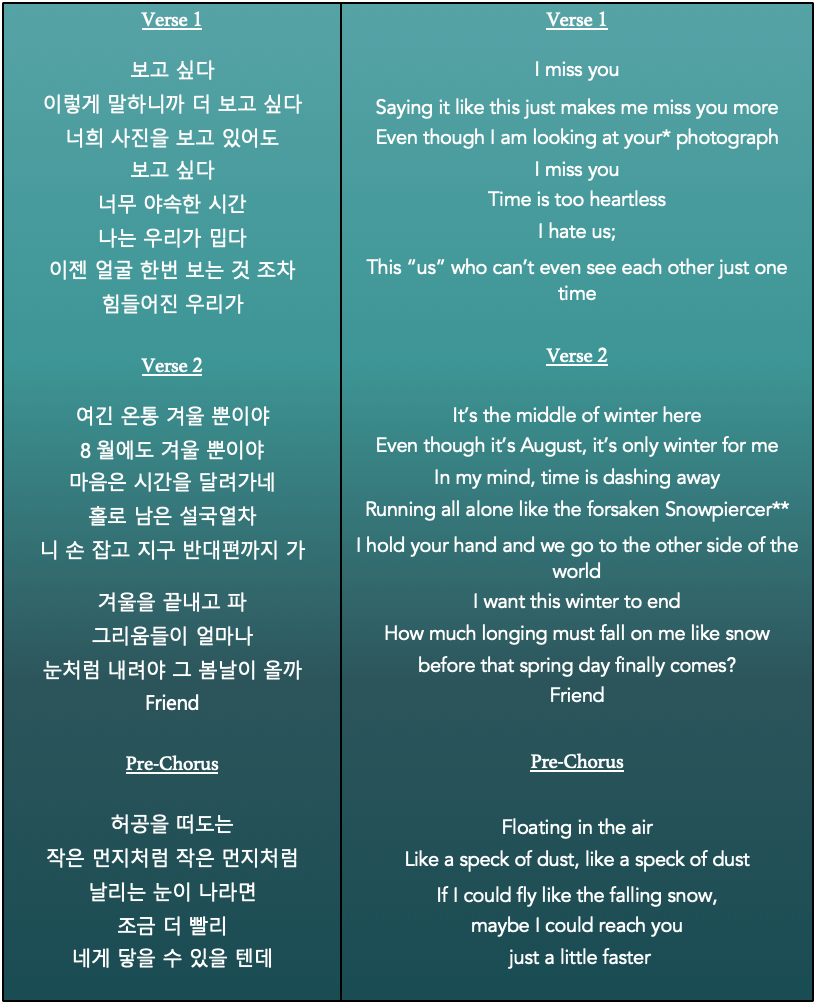
* The “your” here is plural, implying that he is speaking to a group of people, not just one person.
**Snowpierceris in reference to the movie of the same name by Bong Joon-ho that was released in 2013 In the future post-apocalyptic world, the Snowpiercer is a train that circumscribes the entire earth endlessly carrying the last survivors of humanity. RM creates a metaphor of himself and their relationship to this poignant tale.
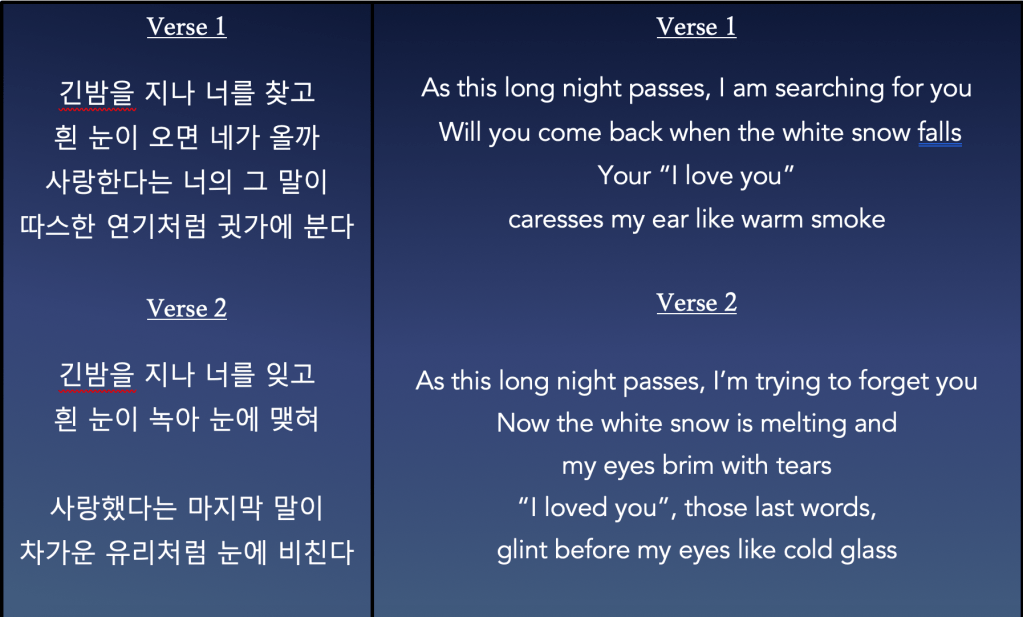
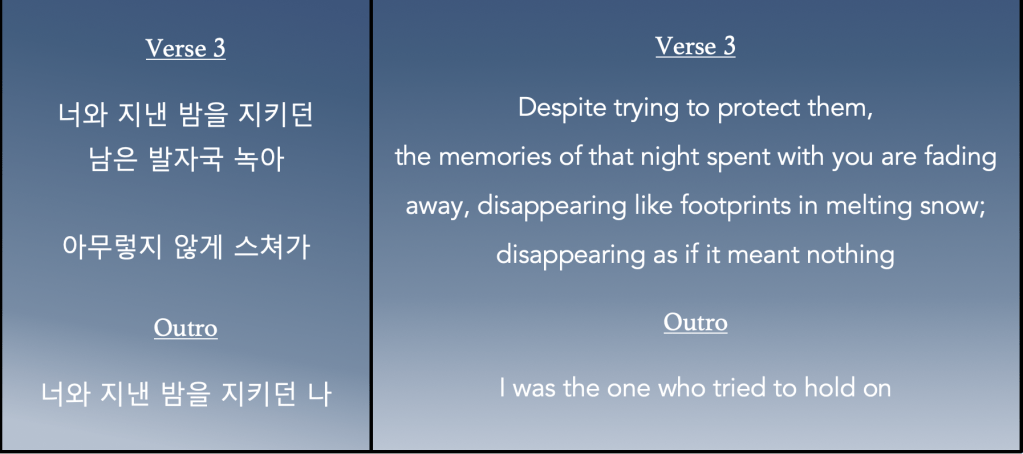
1415-흰 눈이 오면 (When It Snows), from 1415’s 2nd EP [FROM:X] (2018)
This song eloquently and succinctly expresses the feelings of a lover who is grieving their past love.
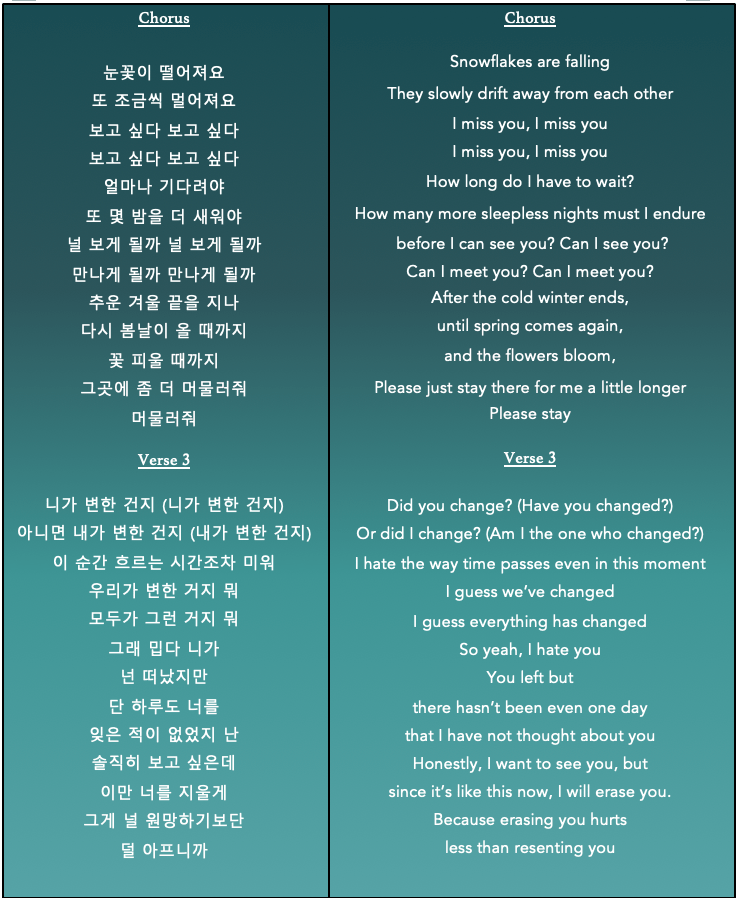
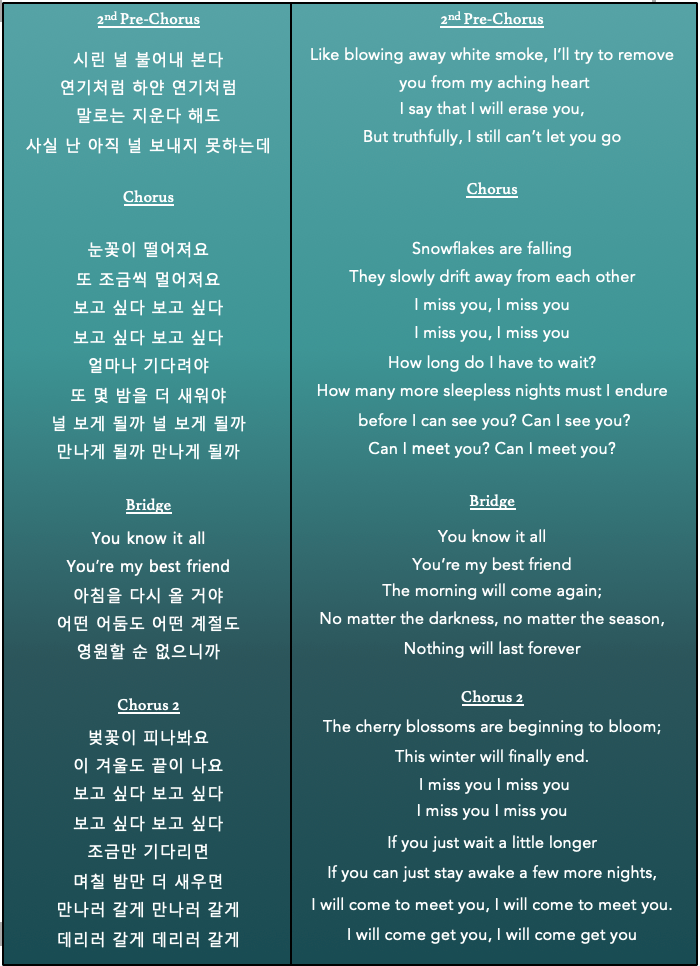
NOTES: Something special that happens in the lyrics, but is difficult to convey through English, is that the singer avoids using the word “I” throughout the entire song until the very last word. In my opinion, this poignant delay conveys that he finally begins to accept this reality and the pain of it; he is beginning to let them go. He stops trying to distance himself from the pain and realizes that he is the only one left trying to hold onto a lover who is not coming back. This theory seems to be supported by the story told in the music video as well.
Side Note: I took the liberty in my translation of taking the phrase “너와 지낸 밤을” (literally “the night spent with you”) to also signify the past memories of their relationship as well as it could be referring to the last night that they saw each other.
(1) It seems to be implied here that because everyone is too preoccupied and busy with their own concerns, they don’t notice him, so he can slow down a little, try breath a little easier.
(2) 그림자 is very often translated as shadow, but it also figuratively means “sadness”. As RM enjoys using figurative language, I assume that he enjoys both meanings of this word, but chose to use sadness as I found that a clearer translation for the sentence in English.
(3) The Korean word for “heels” here also has a figurative meaning of “the lowest level of one’s ability or mind”. As RM is such a poet, I would not be surprised if he meant this line literally and figuratively.
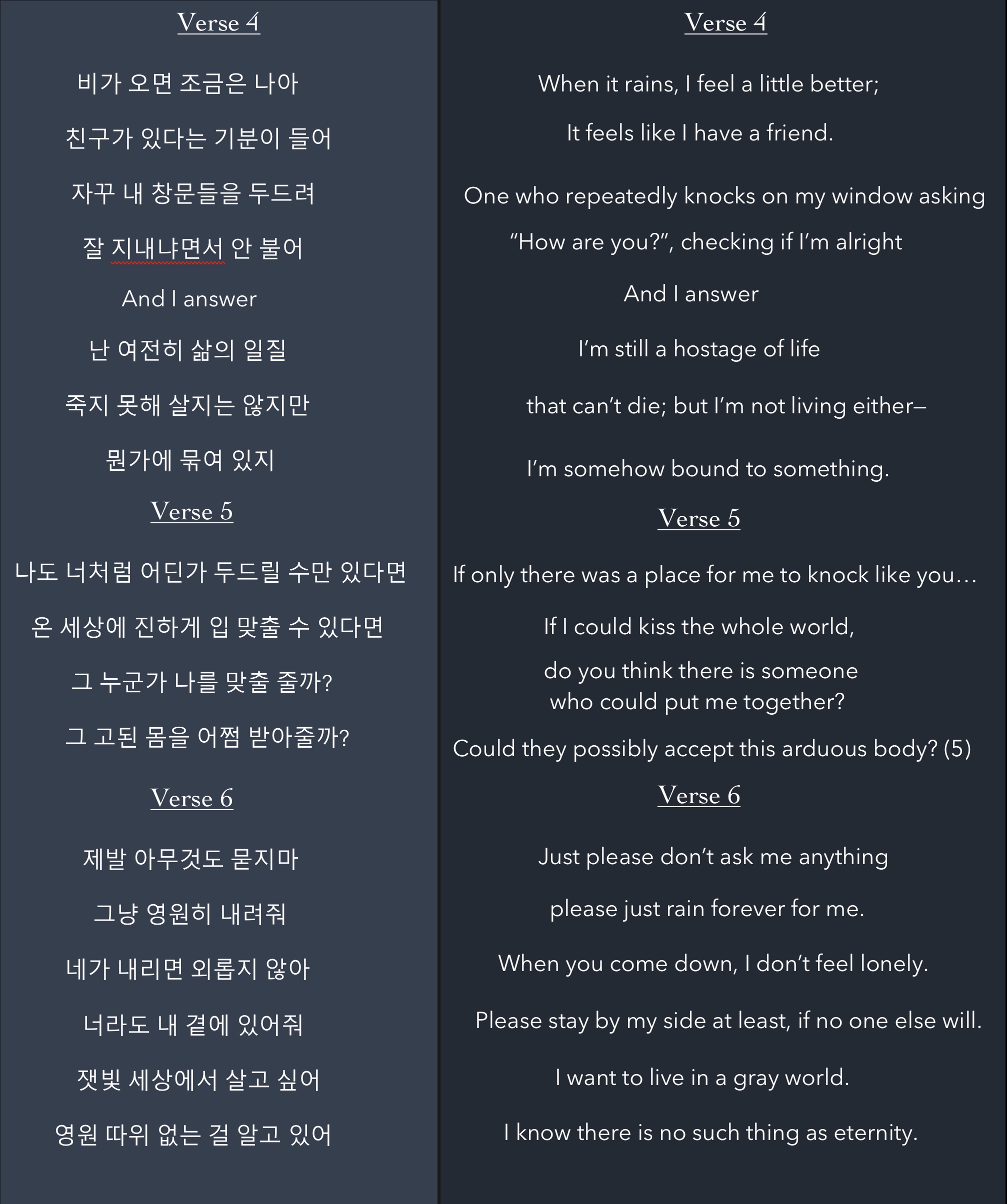
(4) The use of “arduous” is an attempt at conveying the interesting adjective that RM paired with the word “body”. 고되다 has no corresponding word in English, but seems to convey the meanings of difficult, hard, trying, tough, or arduous. The pairing of 고된with 몸 seems be an atypical pairing, as the adjective seems to paired most often with the word for work. So translating it also creates an interesting figurative meaning. I take this to mean that RM feels that even existing in his body, living in it—living as a human—is difficult, hard, trying, etc. As well as with his own internal existential dilemmas and loneliness, it seems, maybe that RM is exhausted by living this thing called life and wonders if there is anyone who could accept him even with all of these complexities.


 파란 나비 Blue Butterfly